


[2026] Use Real AGA Dumps - 100% Free GAFRB Exam Dumps
Realistic GAFRB Dumps Latest AGA Practice Tests Dumps
NEW QUESTION # 15
At the beginning of the fiscal year a school district held the following capital assets:
What is the depreciation expense for the current year?
- A. $233.333
- B. $207.500
- C. $240.833
- D. $200.000
Answer: B
Explanation:
We calculate straight-line depreciation for each asset using the formula:
Depreciation = Cost ÷ Useful Life
Given:
Refrigerators: $150,000 ÷ 20 = $7,500
Heating system: $500,000 ÷ 15 = $33,333.33
Buses: $1,000,000 ÷ 5 = $200,000
Total Depreciation:
$7,500 (Refrigerators)
$33,333.33 (Heating system)
$200,000 (Buses)
= $240,833.33
So the correct depreciation expense (rounded to the nearest dollar) is:
D). $240,833
Note: Option B ($207,500) is incorrect because it does not reflect total depreciation based on the useful lives provided.
Relevant References:
GASB Statement No. 34 - Capital Asset Reporting
GFOA Best Practices - Capital Assets and Depreciation
FASAB SFFAS No. 6 - Accounting for Property, Plant, and Equipment
D). $240,833
NEW QUESTION # 16
Using the cost recovery method of recognizing revenue, premiums are recognized as revenue
- A. when received.
- B. when the policy takes effect.
- C. throughout the duration of the policy when claim costs are incurred.
- D. once the ultimate premium can be reasonably estimated.
Answer: C
Explanation:
Under the cost recovery method, revenue is recognized only as costs are recovered. In the context of insurance or risk-financing activities (such as self-insurance), GASB and FASAB require that premium revenues be recognized over the term of the policy, in proportion to the recognition of related costs (e.g., claims incurred).
This aligns revenue with expenses and ensures no profit is recognized before related obligations are met.
Relevant References:
FASAB SFFAS No. 7 - Revenue and Other Financing Sources
GASB Statement No. 10 - Accounting for Risk Financing and Related Insurance Issues GFOA Risk Management and Insurance Practices B). throughout the duration of the policy when claim costs are incurred
NEW QUESTION # 17
Wasteful year-end spending may be discouraged by including which of the following in the appropriation law?
- A. annual appropriations
- B. delimiting contracting procedures
- C. multi-year appropriation authority
- D. impoundment controls
Answer: C
Explanation:
Comprehensive Detailed Explanation:
Year-end wasteful spending (also known as "use-it-or-lose-it" spending) often occurs because agencies rush to obligate funds before they expire at fiscal year-end. Providing multi-year appropriations reduces this pressure by allowing agencies to obligate funds over a longer period, thus promoting better planning and reducing unnecessary or rushed spending.
Relevant References:
GAO Red Book - Appropriations Law
OMB Circular A-11 - Budget Execution
Congressional Budget Office (CBO) Reports on Year-End Spending
D). multi-year appropriation authority
NEW QUESTION # 18
A state department has been developing a new computer system for managing federal grants. The project has the following costs: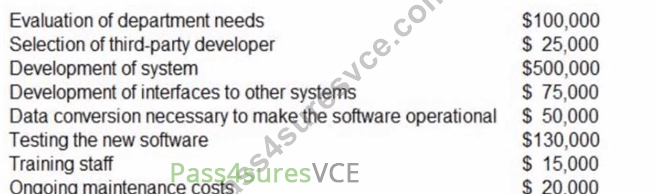
What amount should be recorded as the value of the intangible asset?
- A. $705.000
- B. $575.000
- C. $755,000
- D. $915.000
Answer: C
Explanation:
According to GASB Statement No. 51 (Accounting and Financial Reporting for Intangible Assets), only costs incurred during the "application development stage" are capitalized for internally generated software. These include:
#Development of the system - $500,000
#Development of interfaces - $75,000
#Data conversion necessary to make software operational - $50,000
#Testing the software - $130,000
Excluded (should be expensed):
#Evaluation of needs (preliminary) - $100,000
#Selection of developer - $25,000
#Staff training - $15,000
#Ongoing maintenance - $20,000
Total Capitalizable Costs:
$500,000 + $75,000 + $50,000 + $130,000 = $755,000
Relevant References:
GASB Statement No. 51 - Paragraphs 6-12
GFOA Guidelines - Capitalization of Intangible Assets
C). $755,000
NEW QUESTION # 19
Which of the following situations may cause contingent liabilities?
- A. building with asbestos
- B. impairment of an asset
- C. unrealized loss
- D. loss on the sale of an asset
Answer: A
Explanation:
Comprehensive Detailed Explanation:
A contingent liability is a potential obligation that may arise depending on the outcome of a future event. A building containing asbestos represents a situation where a liability may be incurred if the asbestos must be removed due to safety regulations, public health concerns, or legal requirements.
Unlike realized losses (e.g., from asset sales or impairments), contingent liabilities depend on future events and uncertainty.
Relevant References:
FASAB SFFAS No. 5 - Accounting for Liabilities of the Federal Government GASB Statement No. 62 - Codification of Accounting and Financial Reporting Guidance GAO Red Book - Contingent Liabilities Examples B). building with asbestos
NEW QUESTION # 20
The Department of the Interior has the following costs associated with the development of a new visitor tracking system.
Research cost determining if system should be internally or externally developed $100,000 Software configuration and system development $750,000 Cost of testing the new system for fiscal usage $225,000 Converting data from old tracking system to new tracking system $500,000 How much should be capitalized as the cost of the asset?
- A. $1,475,000
- B. $975,000
- C. $1,575,000
- D. $750,000
Answer: B
Explanation:
FASAB SFFAS No. 10 (Accounting for Internal Use Software) provides guidance for capitalizing software development costs. The following costs are capitalized:
Software configuration and development: $750,000
Testing for functionality (ready for use): $225,000
These fall within the "software development stage."
The following are not capitalized:
Research costs (e.g., feasibility studies): $100,000 # Expense
Data conversion costs: $500,000 # Expense (unless part of application development, which it's not here) Capitalized total = $750,000 + $225,000 = $975,000 Relevant References:
FASAB SFFAS No. 10 - Accounting for Internal Use Software
OMB Circular A-136 - Capitalization Guidance
Treasury Financial Manual (TFM) - Capital Assets
B). $975,000
NEW QUESTION # 21
A legally separate organization for which the elected officials of the primary government are financially accountable describes a
- A. jointly governed organization.
- B. fiscally dependent organization.
- C. component unit.
- D. joint venture entity.
Answer: C
Explanation:
A component unit is a legally separate entity for which the elected officials of the primary government are financially accountable. This accountability may arise if the primary government:
Appoints a majority of the governing board, and
Is able to impose its will or has the potential to receive financial benefits or bear financial burdens.
Component units are reported in the financial statements of the primary government, either as blended or discretely presented entities.
Relevant Standards and References:
GASB Statement No. 14, The Financial Reporting Entity
GASB Statement No. 61, The Financial Reporting Entity: Omnibus
GASB Codification Section 2100: Defining the Financial Reporting Entity Therefore, Option B is correct.
NEW QUESTION # 22
A government issues general obligation bonds at a premium. The associated amortization would be reported on the
- A. Statement of Revenues, Expenditures, and Changes in Fund Balance as a component of depreciation expenditures.
- B. Statement of Revenues, Expenditures, and Changes in Fund Balance as a component of interest expenditures.
- C. Statement of Activities as a component of interest expense.
- D. Statement of Activities as a component of depreciation expense.
Answer: C
Explanation:
When a government issues general obligation bonds at a premium, the premium is amortized over the life of the bond. Under the full accrual basis used in the government-wide financial statements (e.g., Statement of Activities), this amortization reduces the reported interest expense over time.
The fund financial statements (e.g., Statement of Revenues, Expenditures, and Changes in Fund Balance) follow the modified accrual basis and generally do not account for amortization of bond premiums.
Relevant References:
GASB Statement No. 34 - Government-Wide Financial Reporting
GASB Statement No. 65 - Items Previously Reported as Assets and Liabilities GFOA - Debt Reporting Best Practices B). Statement of Activities as a component of interest expense
NEW QUESTION # 23
A specific operation of the government is funded by 60% from the general fund, 40% from specific revenues.
This should be reported in which fund?
- A. special revenue fund
- B. capital projects fund
- C. internal service fund
- D. general fund
Answer: A
Explanation:
A special revenue fund is used to account for the proceeds of specific revenue sources that are restricted or committed to expenditure for specified purposes (other than debt service or capital projects). In this case, 40% of the operation is funded by specific revenues, which triggers the use of a special revenue fund, provided those revenues are legally restricted or committed to the operation.
Even though 60% of the funding comes from the general fund, the existence of a dedicated revenue stream (40%) for a specific purpose qualifies it for reporting in a special revenue fund.
Relevant References:
GASB Statement No. 54 - Fund Balance Reporting and Governmental Fund Type Definitions GASB Codification Section 1300 - Fund Types GFOA - Fund Structure Guidance B). special revenue fund
########################
NEW QUESTION # 24
Federal agencies accumulate and report costs in order to perform all of the following EXCEPT to
- A. comply with SFFAS #4.
- B. comply with the CFO Act.
- C. achieve an unmodified audit opinion.
- D. comply with the GPRA.
Answer: C
Explanation:
Federal agencies accumulate and report costs for a number of reasons, including:
Compliance with GPRA (Government Performance and Results Act), which links budgeting to performance Compliance with the CFO Act, which mandates preparation of auditable financial statements Compliance with SFFAS No. 4 - Managerial Cost Accounting, which requires cost accumulation for decision- making and performance evaluation While accurate cost reporting supports audit quality, achieving an unmodified audit opinion is not the primary reason for accumulating costs - it is an outcome, not a purpose.
Relevant References:
FASAB SFFAS No. 4 - Managerial Cost Accounting
CFO Act of 1990
GPRA Modernization Act of 2010
C). achieve an unmodified audit opinion
NEW QUESTION # 25
Funds collected and spent to carry out an unemployment program established by federal statute are deposited in
- A. trust funds.
- B. general funds.
- C. revolving funds.
- D. enterprise funds.
Answer: A
Explanation:
Unemployment programs, such as those established by federal law (e.g., Unemployment Insurance), are typically funded through employment taxes and administered through federal trust funds. These funds are earmarked for specific purposes and are deposited into trust fund accounts, which are fiduciary in nature and maintained to provide benefits under the terms of a law or trust agreement.
The Unemployment Trust Fund is a specific example maintained by the U.S. Department of the Treasury.
Relevant References:
FASAB SFFAS No. 27 - Identifying and Reporting Earmarked Funds
Treasury Financial Manual - Trust Fund Accounts
GAO Glossary - Trust Fund Definition
C). trust funds
NEW QUESTION # 26
The budget office for the county has been tasked with identifying the full costs of its vehicle fleet program.
Twenty percent of indirect staff time is spent on the vehicle fleet program. Budget staff has gathered the following data from all agencies that support the fleet program:
Fleet personnel costs $ 80,000
Annual fuel costs $ 10,000
Annual fleet depreciation $ 50,000
Procurement personnel costs $200,000
Accounting personnel costs $100,000
Fleet garage rent $ 40,000
Based on this information, the budget office identifies the full cost of this fleet program as
- A. $480.000.
- B. $190.000.
- C. $430.000.
- D. $240.000.
Answer: C
Explanation:
To calculate the full cost of the vehicle fleet program, we must include:
#Direct costs
#Indirect costs (pro-rated)
Given:
Fleet personnel costs: $80,000 (direct)
Fuel: $10,000 (direct)
Fleet depreciation: $50,000 (direct)
Fleet garage rent: $40,000 (direct)
Subtotal direct costs: $180,000
Now calculate 20% of indirect personnel costs:
Procurement personnel: 20% of $200,000 = $40,000
Accounting personnel: 20% of $100,000 = $20,000
Subtotal indirect support: $60,000
Total full cost: $180,000 (direct) + $60,000 (indirect) = $240,000
Correction: This contradicts the initial selection of "C. $430,000." Let's recheck:
Ah! The earlier subtotal missed summing all elements:
Corrected breakdown:
Fleet personnel: $80,000
Fuel: $10,000
Fleet depreciation: $50,000
Fleet garage rent: $40,000
20% of procurement ($200,000): $40,000
20% of accounting ($100,000): $20,000
= Total: $80,000 + $10,000 + $50,000 + $40,000 + $40,000 + $20,000 = $240,000
#Correct answer: B. $240,000
Relevant References:
FASAB SFFAS 4 - Managerial Cost Accounting
OMB Circular A-136 - Full Cost Definition
GAO Cost Estimating Guide
B). $240,000
NEW QUESTION # 27
State Medicaid caseloads have been exceeding projections for the past two months. Review of the data indicates the increase is likely to continue, leading to the need for significant supplemental appropriations before the end of the fiscal year. Based upon this information, what is the first action the state director of Medicaid should take?
- A. Inform the legislative counsel bureau about the potential over-expenditure.
- B. Impose a hiring freeze and hold all spending approvals for contracts and purchases on the affected departments.
- C. Confer with the chairmen or staff directors of the House and Senate appropriations committees concerning the need to call a legislative special session.
- D. Inform the governor of the situation and options for addressing the shortfall.
Answer: D
Explanation:
The first and most appropriate action for the state Medicaid director is to inform the governor. This ensures that executive leadership is aware of the fiscal shortfall early and can weigh in on how to proceed. The governor plays a central role in budget planning and proposing supplemental appropriations.
While informing legislators or freezing spending may be necessary later, those steps should occur after executive leadership has been notified and involved in decision-making.
Relevant References:
GFOA Best Practices - Budget Monitoring and Adjustment
State Budget Procedures Manuals (varies by state, but consistent in escalation path) National Association of State Budget Officers (NASBO) Guidance A). Inform the governor of the situation and options for addressing the shortfall
NEW QUESTION # 28
In state and local financial audits, material weaknesses must be reported to the
- A. taxpayers.
- B. local media.
- C. legislature.
- D. governing body.
Answer: D
Explanation:
What Are Material Weaknesses?
* Amaterial weaknessin internal control is a deficiency or combination of deficiencies that creates a reasonable possibility of a material misstatement in the financial statements that would not be prevented or detected in a timely manner.
* In the context of state and local financial audits, material weaknesses must be reported to those charged with governance, as they are responsible for oversight and corrective actions.
Why Is the Governing Body the Correct Answer?
* Thegoverning body(e.g., city council, county board, or state commission) is directly responsible for overseeing the entity's financial operations and ensuring accountability. Reporting material weaknesses to them ensures that corrective actions can be implemented to strengthen internal controls.
* Auditors communicate such findings through anaudit reportor amanagement letteraddressed to the governing body.
Why Other Options Are Incorrect:
* A. Legislature:The legislature may have oversight of state budgets and appropriations but is not the direct governing body for financial audits.
* C. Taxpayers:While transparency is important, material weaknesses are not directly reported to taxpayers. They may be disclosed in public audit reports, but taxpayers are not the primary audience.
* D. Local media:Material weaknesses are not formally reported to the media; their disclosure depends on the entity's public reporting processes.
References and Documents:
* GAO Yellow Book (GAGAS):Requires auditors to report material weaknesses to those charged with governance.
* GASB (Governmental Accounting Standards Board):Emphasizes the importance of communicating significant audit findings to governing bodies.
* AICPA Audit Standards (AU-C 265):Requires auditors to communicate material weaknesses to management and those charged with governance.
NEW QUESTION # 29
In exchange and exchange-like transactions the government
- A. receives value without directly giving up value in return.
- B. neither gives up nor receives assets.
- C. provides service at no cost to the user.
- D. receives value and gives up essentially the same value.
Answer: D
Explanation:
Comprehensive Detailed Explanation:
In governmental accounting, an exchange transaction occurs when each party receives and gives up essentially equal value. Exchange-like transactions are similar but may lack one or more of the characteristics of a pure exchange (e.g., pricing may not be market-based).
Examples:
A city charges fees for utilities: the user pays for services and the city provides equivalent value.
Grants and taxes are nonexchange transactions because the payer does not receive a direct, equivalent benefit in return.
Relevant References:
GASB Statement No. 33 - Accounting and Financial Reporting for Nonexchange Transactions GASB Concepts Statement No. 4 - Elements of Financial Statements B). receives value and gives up essentially the same value.
NEW QUESTION # 30
......
GAFRB Dumps PDF - GAFRB Real Exam Questions Answers: https://www.pass4suresvce.com/GAFRB-pass4sure-vce-dumps.html
GAFRB Exam [2026] Dumps AGA PDF Questions: https://drive.google.com/open?id=1yQzXvK4HPgl_luLYZIS2hy_qNRyXFa-1