Technology has reshaped how we live and how we learn, and the UiPath-AAPv1 preparation at Pass4suresVCE reflects it: 108 practice questions for the UiPath-AAPv1 exam, three study formats including an offline-capable online version, and verified answers behind every item.
UiPath UiPath-AAPv1 Exam Overview:
| Certification Vendor: | UiPath |
|---|---|
| Exam Name: | UiPath Agentic Automation Professional Exam |
| Exam Number: | UiPath-AAPv1 |
| Exam Format: | Sequencing, Multiple-choice, Drag-and-drop |
| Passing Score: | 70% |
| Related Certifications: | UiPath Certified Professional Agentic Automation Professional UiPath Agentic Automation Associate (UiPath-AAAv1) |
| Exam Duration: | 120 minutes |
| Available Languages: | Japanese, English |
| Certificate Validity Period: | 3 years from the date of credential achievement |
| Exam Price: | USD 300 (plus any applicable taxes) |
| Sample Questions: |  |
| Exam Way: | Available at Pearson VUE test centers and through online proctored testing. The exam uses multiple-choice, drag-and-drop, and sequencing question formats. Exam duration is 120 minutes. The official exam description does not specify the total number of questions or domain weight percentages. |
| Pre Condition: | No mandatory prerequisite exam is specified in the official exam description. UiPath recommends familiarity with end-to-end automation workflow design, agent validation, guardrails, governance, and monitoring, as well as hands-on experience building and testing UiPath solutions. Passing UiPath Agentic Automation Associate is recommended for candidates seeking the next certification level but is not stated as a mandatory prerequisite. |
| Official Syllabus URL: | https://start.uipath.com/rs/995-XLT-886/images/UiPath%20Agentic%20Automation%20Professional%20Exam%20Description.pdf |
UiPath UiPath-AAPv1 Exam Syllabus Topics:
| Section | Objectives |
|---|---|
| UI Agent | - UI Agent (ScreenPlay) |
| Agentic discovery and blueprint design | - Selecting tools appropriate to agent objectives - Assessing agentic automation opportunities in business processes - Designing agent stories using triggers, instructions, context, human-in-the-loop requirements, and tools - Prioritizing automation opportunities based on feasibility and impact - Defining agent goals and evaluation criteria - Mapping business process steps to agent tasks - Mapping context sources and grounding strategies - Differentiating system prompts and user prompts |
| Agentic AI and agentic automation concepts | - Agentic orchestration and collaboration between robots, agents, and humans - Definitions of agents and distinctions between generative AI and agentic AI - Best practices for agentic automation, including intelligent decision-making, adaptability, goal-oriented execution, and multi-task coordination |
| AI Trust Layer | - Using audit logs and usage summaries - Personally identifiable information masking in transit - Using a custom tenant as an LLM gateway |
| Agentic orchestration with UiPath Maestro | - Using Send and Receive tasks with Integration Service connectors and webhooks - Defining and using API workflows - Handling asynchronous agent completion events and callbacks - Maestro best practices - Configuring User Tasks with Action Apps forms for escalations - Mapping input and output parameters between Maestro tasks and agents - Using the expression editor and scripts for data transformation and conditional routing - Configuring Service Tasks to invoke automation workflows from Orchestrator - Configuring dynamic assignees, SLAs, and expiry rules for user tasks - Configuring Service Tasks to invoke agents using Start and wait for agent - Defining global, local, and task-specific process variables - Capturing user inputs and returning structured data to processes - Maestro control flow - Instance management - Chaining multiple agents within a process - Using BPMN to model business processes and assign tasks to robots, agents, and humans |
| Agent management | - Monitoring agent usage, unit consumption, and incidents - Using agent scores to track performance - Agent tool and context grounding simulations - Analyzing execution traces to understand agent behavior - Applying governance policies to enable, disable, and control agent functionality - Best practices for building, publishing, and deploying agents - Assigning policies at tenant, group, and user levels |
| Prompt engineering | - Designing structured few-shot prompts - Prompt engineering best practices - Applying clarity, specificity, and conciseness - Including context, instructions, output formats, and constraints - Crafting zero-shot prompts for simple tasks - Iteratively refining prompts based on evaluation feedback |
| Escalations | - Defining escalation logic - Configuring UiPath Action Apps for human-in-the-loop escalations - Human-in-the-loop concepts and the importance of human oversight |
| Coded Agents | - Coded Agents |
| Conversational Agents | - Conversational Agents |
| Autopilot for Everyone | - Determining when to use Autopilot for Everyone - Using specialized Autopilots |
| Context Grounding | - Context grounding sources and configuration options - Context engineering best practices - Ingestion and retrieval methods - Monitoring index queries and jobs - Context grounding concepts and implementation - Implementing index update strategies - Configuring thresholds and result limits for precision and relevance - Using context grounding indexes to store and retrieve relevant information for agent memory |
| Agentic evaluations | - Creating input-output pairs for diverse scenarios - Identifying edge cases and failure scenarios - Designing evaluation datasets that reflect real-world complexity - Differences between deterministic and model-graded evaluations - Evaluation concepts and their role in agent reliability - Executing evaluation sets and analyzing accuracy and reliability - Interpreting evaluation scores - Optimizing prompts using evaluation results - Analyzing evaluation failures to identify root causes and error patterns - Selecting deterministic and model-graded assertions - Iteratively improving agent performance - Selecting strict or flexible assertions based on use cases - Using execution traces to troubleshoot failed evaluations |
| UiPath Platform components and integrations | - Applying agent tool guardrails - Mapping connector actions into agent prompts - Reusing existing agents within new agents - Building and publishing API workflows as reusable agent tools - Designing input and output schemas for tools - Using Run Job in Studio Web - Creating agent tools in Studio Web - Troubleshooting tool execution using traces and evaluations - Creating connections through Integration Service - Data Fabric integration - Integrating MCP assets as agent tools |
UiPath Agentic Automation Professional Materials That Go Where You Go
- Agentic AI and agentic automation concepts ()
- Agentic orchestration with UiPath Maestro ()
- Conversational Agents ()
UiPath Agentic Automation Professional Sample Questions:
When setting up a Context Grounding index in UiPath Orchestrator, which of the following describes a correct combination of source type and required setup steps?
- A. Choose Storage Bucket as the source and leave the file type unspecified, since Orchestrator automatically detects all file types by default.
- B. Choose Connector, then directly upload files into Orchestrator without selecting a connection or specifying a folder path.
- C. Choose Connector and upload data directly into the index without selecting an external storage service by dragging and dropping the documents.
- D. Choose Storage Bucket as the data source and then select the Orchestrator folder containing the bucket and the matching file types.
Correct Answer: D 🗳️
Explanation: Only visible for Pass4suresVCE members. You can sign-up / login (it's free).
Which of the following is a properly structured system prompt based on best practices?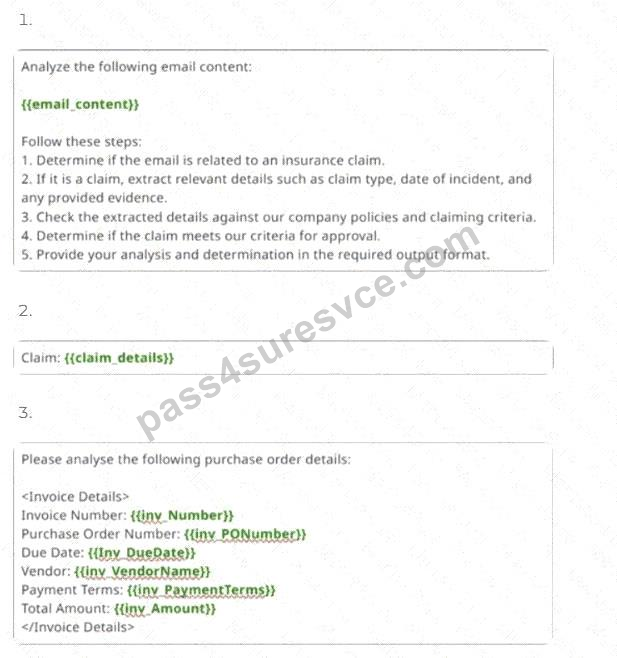
Original exhibit - Question 6, part 1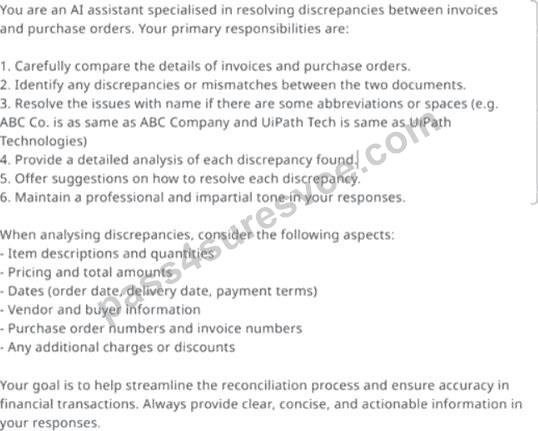
Original exhibit - Question 6, part 2
- A. 1
- B. 3
- C. 4
- D. 2 and 4
Correct Answer: C 🗳️
Explanation: Only visible for Pass4suresVCE members. You can sign-up / login (it's free).
Before publishing an agent to Orchestrator, which combination of checks ensures the agent meets enterprise readiness standards?
- A. Conduct at least 50 interactive tests and confirm no regressions.
- B. Run smoke tests only after publishing, and make sure the provided guardrail logging is enabled.
- C. Conduct at least 30 interactive tests, validate evaluation sets with #70% performance.
- D. Skip interactive testing if curated evaluations exceed 80% accuracy.
Correct Answer: C 🗳️
Explanation: Only visible for Pass4suresVCE members. You can sign-up / login (it's free).
An organization is assessing a proposed agent story to determine whether it meaningfully addresses operational challenges.
Which evaluation criterion aligns most directly with agentic discovery principles?
- A. Verify that the agent story expands automation scope beyond the boundaries of the documented workflow.
- B. Verify that the agent story increases the total number of automated steps across the process.
- C. Verify that the agent story corresponds to documented inefficiencies and decisions from the "as-is" analysis.
- D. Verify that the agent story introduces additional architectural complexity to support future scalability.
Correct Answer: C 🗳️
Explanation: Only visible for Pass4suresVCE members. You can sign-up / login (it's free).
Which filters can be applied to refine the data displayed on the Monitoring tab?
- A. Only basic filters such as version and date range are available, element and variable-level filters are not supported.
- B. Advanced filters override basic filters completely, making version and date range irrelevant when both are applied.
- C. Filters can only be applied after exporting the data, the Monitoring tab itself does not support filtering.
- D. You can apply both basic filters and advanced filters to refine the displayed data.
Correct Answer: D 🗳️
Explanation: Only visible for Pass4suresVCE members. You can sign-up / login (it's free).
Viewing page 1 out of 22 pages.
Viewing questions 1-5 out of 108 questions.


 4 Customer Reviews