


Latest WRT Pass Guaranteed Exam Dumps with Accurate & Updated Questions
WRT Exam Brain Dumps - Study Notes and Theory
NEW QUESTION # 20
If outdoor conditions are favorable, what can be reduced with ventilation?
- A. Sublimation
- B. Humidity ratio
- C. Microbial growth
- D. Static electricity
Answer: B
Explanation:
The IICRC WRT body of knowledge explains that when outdoor air has alower humidity ratiothan indoor air, ventilation can be used to reduce the indoor humidity ratio by replacing moist air with drier outside air.
This reduction directly supports evaporation and drying.
Ventilation works by exchanging air masses. If the incoming air contains less moisture per pound of dry air, the overall moisture content of the drying chamber decreases. The WRT manual stresses that psychrometric comparison-not temperature or relative humidity alone-must be used to determine whether outdoor air is suitable.
Ventilation does not directly reduce microbial growth; rather, it reduces moisture conditions that support microbial amplification. Static electricity and sublimation are unrelated to ventilation drying.
Properly applied ventilation is recognized by the WRT standard as a legitimate moisture removal method when conditions allow, though it must be monitored to ensure effectiveness and prevent unintended moisture introduction.
NEW QUESTION # 21
What is the atmospheric condition with the lowest humidity ratio?
- A. 40°F (4°C) and 80% RH
- B. 70°F (21°C) and 80% RH
- C. 90°F (32°C) and 30% RH
- D. 80°F (27°C) and 60% RH
Answer: A
Explanation:
The IICRC WRT body of knowledge teaches thathumidity ratiorepresents the actual mass of water vapor contained in air and is independent of relative humidity alone. To determine which condition has the lowest humidity ratio, both temperature and relative humidity must be considered together using psychrometric principles.
Cool air holds significantly less moisture than warm air, even at higher relative humidity percentages. At40°F and 80% RH, the air contains very little moisture compared to warmer air at lower RH values. In contrast, warmer air-even at 30-60% RH-typically contains more total moisture due to its greater vapor-holding capacity.
The WRT manual emphasizes that relying solely on relative humidity is misleading. Psychrometric evaluation is required when comparing air conditions for ventilation drying. Among the listed options, 40°F and 80% RH has the lowest humidity ratio and therefore the driest air in terms of moisture content.
This principle reinforces why cold outdoor air can sometimes be effective for ventilation drying, provided condensation risks are managed.
NEW QUESTION # 22
What should a restorer do when a carpet is affected by Category 3 water and a materially interested party disagrees with removal?
- A. Call the health department for approval to proceed
- B. Double the number of antimicrobials applied
- C. Clean and save the carpet if possible
- D. Stop work until the conflict has been resolved
Answer: D
Explanation:
The IICRC WRT body of knowledge states thatcarpet affected by Category 3 water is not restorableand must be removed and discarded due to gross contamination. However, when a materially interested party disputes this requirement, the restorer muststop work until the conflict is resolved.
Proceeding against the expressed objection of an owner, occupant, or insurer exposes the restorer to legal and financial liability. The WRT manual emphasizes that restorers must not perform disputed work without proper authorization, even when technical standards clearly indicate removal is required.
Cleaning, saving, or applying additional antimicrobials does not make Category 3-affected carpet safe or compliant with IICRC standards. Antimicrobials cannot neutralize sewage-level contamination embedded within porous materials.
Stopping work allows time for consultation, documentation, expert input, or formal dispute resolution. This approach protects all parties and maintains professional integrity while adhering to health and safety principles.
NEW QUESTION # 23
If indoor conditions are 90°F (32°C) and 60% relative humidity, at what surface temperature does condensation begin to occur?
- A. 88°F (31°C)
- B. 52°F (11°C)
- C. 74°F (23°C)
- D. 58°F (14°C)
Answer: C
Explanation:
Condensation occurs when a surface temperature reaches or drops below thedew point temperatureof the surrounding air. The IICRC WRT body of knowledge emphasizes that dew point-not relative humidity alone-determines when condensation will form.
At90°F and 60% RH, the corresponding dew point is approximately74°F. Any surface at or below this temperature will experience condensation as water vapor changes phase from gas to liquid.
This principle is critical in restoration drying because unintended condensation can re-wet materials and cause secondary damage. The WRT curriculum trains restorers to monitor both air dew point and material surface temperatures to prevent this condition.
Lower temperature options listed would represent colder surfaces but condensation would already occur once the surface reaches the dew point. Therefore, 74°F is the correct threshold.
NEW QUESTION # 24
A technician has arrived at a large vacant home where the basement is lightly affected and is considered a Class 1. There are six LGR dehumidifiers on the truck that each have an AHAM rating of 110 pints per day (PPD). How many are initially recommended to be placed if the affected area is 22,000 cubic feet?
- A. 0
- B. 1
- C. 2
- D. 3
Answer: C
Explanation:
The IICRC WRT body of knowledge provides guidance for determining initial dehumidification capacity based oncubic footage,class of water, andtype of dehumidifier. ForClass 1 water intrusions, which involve minimal moisture absorption and evaporation primarily from structural materials, the recommended starting point is approximatelyone LGR dehumidifier per 10,000 to 12,000 cubic feetof affected space.
In this scenario, the basement volume is 22,000 cubic feet. Applying the WRT initial calculation method, dividing 22,000 cubic feet by 10,000-12,000 cubic feet per unit results in a requirement of approximatelytwo LGR dehumidifiers. Although six units are available on the truck, the WRT standard emphasizes that equipment placement should be based on need-not availability. Over-dehumidification can be inefficient, unnecessary, and difficult to justify to materially interested parties.
The WRT manual also stresses that this is aninitial recommendation, subject to adjustment after psychrometric monitoring confirms whether drying goals are being met. Because the structure is vacant and the intrusion is Class 1, the moisture load is relatively low, and excessive equipment would not improve drying efficiency. Instead, proper airflow, monitoring, and controlled humidity reduction are the priority.
This approach aligns with IICRC principles that restorers should place sufficient equipment to create effective drying conditions without introducing waste, excessive power consumption, or unjustified costs.
NEW QUESTION # 25
When performing the initial inspection, which of the following could help determine the perimeter of wet carpet and cushion (pad, underlay)?
- A. Use an IR camera or moisture sensor
- B. Disengage the installation
- C. Use a borescope or anemometer
- D. Feel the area for moisture
Answer: A
Explanation:
The IICRC WRT body of knowledge recommends usinginfrared (IR) cameras and moisture sensorsto help determine the perimeter of wet carpet and cushion during the initial inspection. These tools allow restorers to quickly and non-destructively identify moisture patterns across large areas.
IR cameras can highlight temperature anomalies caused by evaporative cooling, while moisture sensors provide confirmation of moisture presence beneath carpet surfaces. The WRT manual stresses that IR imaging must always be verified with moisture detection instruments to avoid false positives.
Disengaging carpet or relying on touch is invasive, time-consuming, and unreliable. Borescopes and anemometers are not designed for carpet moisture detection.
Using appropriate detection tools supports accurate scoping, efficient drying design, and defensible documentation-core principles of professional restoration practice under the IICRC WRT standard.
NEW QUESTION # 26
Who should a technician get documented authorization from before applying an antimicrobial (biocide)?
- A. The owner or occupant
- B. The primary physician
- C. The reconstruction contractor
- D. The primary adjuster
Answer: A
Explanation:
The IICRC WRT body of knowledge clearly states that before applying an antimicrobial (biocide), a technician must obtaindocumented authorization from the owner or occupant, or another legally authorized representative of the property. This requirement exists because antimicrobial application involves introducing regulated chemical agents into an occupied environment, which carries potential health, legal, and liability implications.
The WRT manual emphasizes informed consent as a professional and ethical obligation. Owners or occupants must be made aware of the purpose, limitations, and potential risks associated with antimicrobial use.
Documented authorization protects all materially interested parties by confirming that the decision to apply a biocide was disclosed, understood, and approved.
Insurance adjusters do not have authority over health decisions within a structure, reconstruction contractors do not represent occupancy interests, and physicians are not responsible for property treatment approvals. The responsibility lies with the property owner or occupant.
This requirement aligns with EPA pesticide regulations and the ANSI/IICRC S500 Standard, reinforcing transparency, safety, and defensibility in restoration practices.
NEW QUESTION # 27
SCENARIO: Use the diagram and information below to answer this question.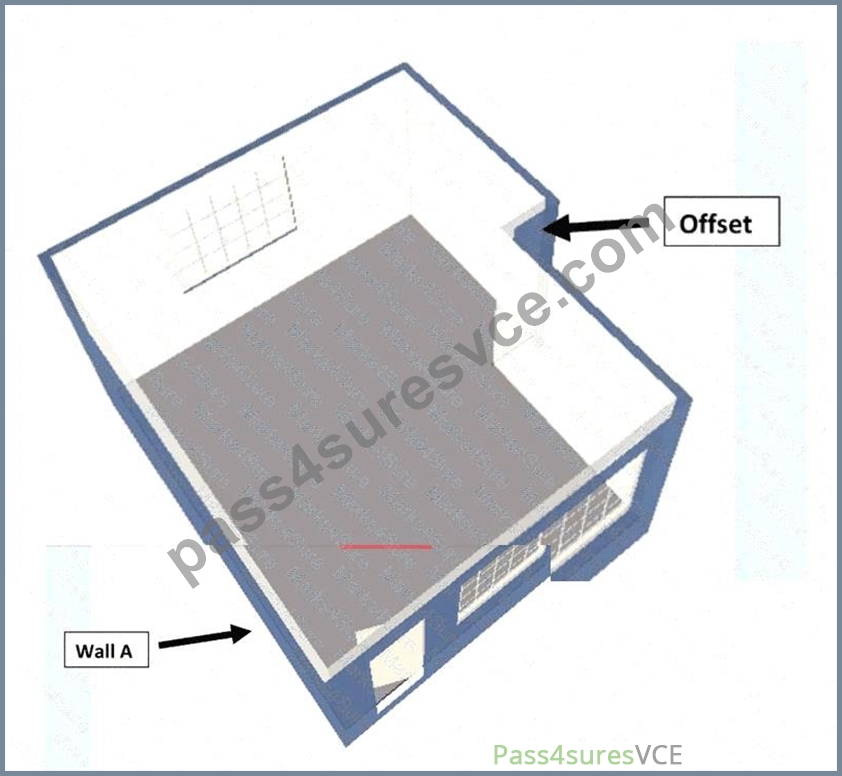
. The living room measures 20 feet x 16 feet, with an offset measuring 10 feet x 2 feet.
. The ceiling height is 8 feet.
. The entire floor area is wet, and moisture has been detected as high as 21 inches on all walls except Wall A.
. Water escaped from a broken pipe located behind Wall A. The entire area of wall A is wet.
. The ceiling is not affected.
Important information:
. The total square footage of the floor, including the offset, is 340 square feet
. The total square footage of Wall A after deducting the bottom 2 feet is 120 square feet (USE THE SCENARIO) What is the total number of airmovers a restorer should install?
- A. Total of 12
- B. Low Range 7, High Range 10
- C. Low Range 5, High Range 8
- D. Low Range 8, High Range 11
Answer: B
Explanation:
Based on IICRC WRT initial air mover placement guidelines:
* Floor area:340 sq ft # typically1 air mover per 50-70 sq ft
* Low range # 5-7
* High range # 7-9
* Wall drying required:
* All walls affected up to 21 inchesexcept Wall A
* Wall A fully wet(above 2 ft deduction = 120 sq ft requiring full wall drying)
* Offsets and irregular geometryincrease airflow demand.
When combining:
* Floor drying requirement
* Additional air movers forsignificantly wet walls
* One fully saturated wall (Wall A)
* One offset area
NEW QUESTION # 28
On a Class 4 water intrusion that is 2,000 square feet with an 8-foot ceiling height, how many 400 CFM desiccant dehumidifiers would you need initially?
- A. 0
- B. 1
- C. 2
- D. 3
Answer: D
Explanation:
The IICRC WRT body of knowledge explains that Class 4 water intrusions involve deeply held or bound water and typically require specialized drying methods, including desiccant dehumidification. Initial desiccant sizing is based on cubic footage and airflow capacity rather than AHAM pints.
In this scenario, the affected volume is 2,000 square feet × 8 feet = 16,000 cubic feet. A common WRT starting guideline for desiccant systems is approximately one 400 CFM desiccant unit per 8,000 cubic feet for Class 4 conditions.
Dividing 16,000 cubic feet by 8,000 cubic feet per unit results in an initial recommendation of two 400 CFM desiccant dehumidifiers. This capacity provides sufficient airflow and moisture adsorption to manage the heavy moisture load typical of Class 4 losses.
The WRT manual stresses that this is an initial recommendation and must be validated through psychrometric monitoring and material moisture readings. Desiccant systems are often adjusted as drying progresses.
NEW QUESTION # 29
What is it called when moisture causes wood flooring to expand, resulting in the edges being higher than the center across the width of the board?
- A. Cupping
- B. Crowning
- C. Delaminating
- D. Buckling
Answer: A
Explanation:
Cuppingis the correct term used in the IICRC WRT body of knowledge to describe a condition where wood flooring expands due to moisture, causing the edges of each board to rise higher than the center. This deformation occurs because moisture is absorbed unevenly-typically from below-causing differential expansion across the board's thickness.
The WRT manual explains that cupping is most commonly associated with moisture intrusion affecting subflooring or elevated humidity conditions beneath the flooring. As the underside of the board absorbs moisture, it expands more than the top surface, resulting in a concave shape across the width.
This condition is distinct fromcrowning, which is the opposite deformation where the center is higher than the edges, often occurring after sanding cupped floors before moisture equilibrium is restored.Bucklingrefers to extreme deformation where boards lift completely from the subfloor, anddelaminationapplies to layered materials separating.
Understanding cupping is essential for restorers because it influences drying strategy, expectations, and post- drying recommendations. The WRT standard emphasizes careful moisture control and adequate acclimation time to allow wood flooring to return as close as possible to its original profile before repairs or refinishing are attempted.
NEW QUESTION # 30
Which material loses most of its structural integrity when wet but regains its strength when dry?
- A. Gypsum board (drywall)
- B. Hardwood flooring
- C. Concrete
- D. Plywood
Answer: A
Explanation:
Gypsum board (drywall) is identified in the WRT body of knowledge as highly vulnerable to moisture exposure, yet capable of recovering strength when dried-provided it has not sustained irreversible primary damage. The WRT manual explains that gypsum wallboard is among the most moisture-sensitive common building materials, showing rapid and dramatic change with elevated moisture levels. However, it also states that gypsum has a greater ability to recover than many other engineered products.
Critically, the WRT guidance distinguishes between primary damage (immediate structural failure) and recoverable wetting. For example, overhead or horizontally installed gypsum that becomes wet can lose structural integrity, sag, and create a significant safety concern; this sagging is considered permanent damage and requires removal.
In contrast, when gypsum board installed vertically on walls is wet but has not experienced primary damage (e.g., not structurally compromised, not severely deteriorated, and appropriate contamination considerations are addressed), the WRT manual notes that it can restore: during the drying process, gypsum's original strength is restored, and after drying it may even be slightly stronger (though sometimes more brittle). This recovery characteristic is what makes gypsum board the best match to the question's description-losing structural integrity when wet yet regaining strength when properly dried.
This material behavior is central to WRT decision-making: whether to dry in place, perform limited disruption (e.g., baseboard removal and cavity airflow), or remove materials for safety/health reasons. The WRT body of knowledge treats gypsum as potentially restorable depending on installation orientation, degree of damage, and contamination risk, which is why it is specifically described as losing integrity when wet and regaining strength when dry.
NEW QUESTION # 31
Which of the following is defined as removing water vapor from the air?
- A. Humidification
- B. Diffusion
- C. Evaporation
- D. Dehumidification
Answer: D
Explanation:
The IICRC WRT body of knowledge definesdehumidificationas the process of removing water vapor from the air. This process is fundamental to restorative drying because evaporation alone does not remove moisture from a structure; it only changes liquid water into vapor. Without dehumidification (or ventilation), evaporated moisture would remain in the air and eventually re-condense on cooler surfaces.
The WRT curriculum explains that dehumidification works by reducing thehumidity ratio and vapor pressureof the air, thereby maintaining a vapor pressure differential that allows moisture to continue moving from wet materials into the surrounding environment. Refrigerant dehumidifiers accomplish this through condensation, while desiccant dehumidifiers remove moisture through adsorption.
Dehumidification must be properly balanced with airflow and temperature control. The WRT manual emphasizes that excessive evaporation without adequate dehumidification can increase ambient humidity, slow drying, and raise the risk of secondary damage. Conversely, effective dehumidification lowers relative humidity, reduces dew point, and supports sustained evaporation from wet materials.
Humidification is the opposite process, diffusion is passive vapor movement, and evaporation is only one step in the drying cycle. Only dehumidification actively removes water vapor from the air mass, making it the correct definition under WRT standards.
NEW QUESTION # 32
What do moisture detection instruments allow a restorer to evaluate and document?
- A. Psychrometric conditions and moisture content or level readings
- B. Manometer readings for the purpose of drying
- C. Thermographic readings and images from a thermal camera
- D. Count particulates of aerosolized contaminants
Answer: A
Explanation:
The IICRC WRT body of knowledge states that moisture detection instruments allow restorers to evaluate and documentpsychrometric conditions and moisture content or moisture level readings. These measurements form the foundation of drying verification and defensible documentation.
Moisture meters measure moisture within materials, while thermo-hygrometers capture air temperature and relative humidity, enabling calculation of dew point, humidity ratio, and vapor pressure. Together, these tools allow restorers to assess drying effectiveness, establish drying goals, and demonstrate progress over time.
Thermal imaging provides indirect information and must be verified, while manometers and particulate counters serve specialized purposes outside routine moisture documentation.
The WRT manual emphasizes consistent measurement, proper instrument selection, and clear documentation as essential components of professional restoration practice and project closeout.
NEW QUESTION # 33
What should a restorer do when pre-existing damage is discovered?
- A. Document and discuss only with the insurance adjuster
- B. Increase pricing to cover the pre-existing damage
- C. Document and inform all materially interested parties
- D. Treat all areas as if only primary water damage
Answer: C
Explanation:
The IICRC WRT body of knowledge requires thatpre-existing damage be documented and disclosed to all materially interested parties. This includes property owners, occupants, insurers, and other stakeholders with a financial or legal interest in the project.
Pre-existing damage may include deterioration, staining, microbial growth, or structural issues unrelated to the current water loss. The WRT manual emphasizes that failing to document such conditions can expose restorers to disputes, denied claims, or allegations of causing damage that already existed.
Documentation should include written descriptions, photographs, moisture readings, and notes distinguishing pre-existing conditions from water-loss-related damage. Transparency ensures informed decision-making and protects the restorer from liability.
Limiting disclosure to only the adjuster or ignoring pre-existing damage violates professional standards.
Increasing pricing or misclassifying damage is inappropriate. The WRT standard prioritizes accurate documentation and ethical communication.
NEW QUESTION # 34
Which of the following is an initial method to search for moisture in surfaces such as wood flooring, gypsum wallboard, resilient flooring, ceramic tile, and plaster?
- A. Remove one section of material
- B. Use a penetrating (invasive) moisture meter
- C. Drill small holes in the grout
- D. Use a non-penetrating (non-invasive) moisture meter
Answer: D
Explanation:
The IICRC WRT body of knowledge identifiesnon-penetrating (non-invasive) moisture metersas the preferredinitialmethod for surveying moisture in a wide range of building materials. These devices allow restorers to rapidly scan large surface areas without damaging finished materials, making them ideal for initial inspection and moisture mapping.
Non-invasive meters work by emitting electromagnetic signals that respond to changes in material density and moisture presence. While they do not provide precise moisture content values, they are effective at identifying areas of concern that warrant further investigation.
The WRT manual stresses that invasive meters, material removal, or drilling should only be performedafter non-invasive methods indicate elevated readings and when confirmation is required. This tiered approach minimizes unnecessary damage while still ensuring accurate assessment.
Additionally, non-invasive meters are particularly useful on surfaces like ceramic tile or plaster, where penetrating probes may be impractical or destructive. Proper documentation requires that readings be repeatable and defensible, and starting with non-invasive tools supports both goals.
NEW QUESTION # 35
What is the term for the force exerted by water molecules in the air on surrounding surfaces?
- A. Humidity ratio
- B. Dew point
- C. Relative humidity
- D. Vapor pressure
Answer: D
Explanation:
Vapor pressureis defined in the IICRC WRT body of knowledge as the force exerted by water vapor molecules in the air against surrounding surfaces. It represents the energy level of moisture in the air and is a key driver of moisture movement.
The WRT manual explains that water vapor moves from areas of higher vapor pressure to areas of lower vapor pressure, whether between materials and air or between different air masses. This principle governs evaporation, condensation, and moisture redistribution within a drying chamber.
Relative humidity describes a percentage relationship, humidity ratio measures moisture mass, and dew point identifies saturation temperature-but vapor pressure quantifies the actualdriving force. Because vapor pressure is directly influenced by both temperature and humidity ratio, it is considered one of the most precise indicators of drying potential.
Effective drying systems focus on lowering air vapor pressure relative to wet materials, ensuring continuous moisture migration out of structural components.
NEW QUESTION # 36
When using LGR dehumidifiers in a Class 3 water intrusion containing 9,000 cubic feet, what is the recommended dehumidification capacity?
- A. 450 PPD (pints per day)
- B. 300 PPD (pints per day)
- C. 225 PPD (pints per day)
- D. 325 PPD (pints per day)
Answer: A
Explanation:
The IICRC WRT body of knowledge provides guidance for initial LGR dehumidification capacity based on cubic footage and class of water. For Class 3 intrusions, which involve the greatest amount of moisture absorption and evaporation (excluding Class 4), a higher dehumidification capacity is required.
A commonly taught WRT guideline is approximately one LGR dehumidifier (#150 PPD) per 3,000 cubic feet for Class 3 conditions. Applying this to a 9,000 cubic foot drying chamber results in a total recommended capacity of approximately 450 PPD.
This capacity ensures that evaporated moisture is removed efficiently, preventing elevated humidity and secondary damage. The WRT curriculum emphasizes that insufficient dehumidification in Class 3 losses can stall drying and increase microbial risk.
As with all equipment recommendations, this is an initial placement subject to adjustment based on monitoring data, but 450 PPD represents the correct starting capacity under WRT guidance.
NEW QUESTION # 37
Which material loses most of its structural integrity when wet but regains its strength when dry?
- A. Gypsum board (drywall)
- B. Hardwood flooring
- C. Concrete
- D. Plywood
Answer: A
Explanation:
Gypsum board (drywall) is identified in the WRT body of knowledge as highly vulnerable to moisture exposure, yet capable of recovering strength when dried-provided it has not sustained irreversible primary damage. The WRT manual explains that gypsum wallboard is among the most moisture-sensitive common building materials, showing rapid and dramatic change with elevated moisture levels. However, it also states that gypsum has a greater ability to recover than many other engineered products.
Critically, the WRT guidance distinguishes between primary damage (immediate structural failure) and recoverable wetting. For example, overhead or horizontally installed gypsum that becomes wet can lose structural integrity, sag, and create a significant safety concern; this sagging is considered permanent damage and requires removal.
In contrast, when gypsum board installed vertically on walls is wet but has not experienced primary damage (e.g., not structurally compromised, not severely deteriorated, and appropriate contamination considerations are addressed), the WRT manual notes that it can restore: during the drying process, gypsum's original strength is restored, and after drying it may even be slightly stronger (though sometimes more brittle). This recovery characteristic is what makes gypsum board the best match to the question's description-losing structural integrity when wet yet regaining strength when properly dried.
This material behavior is central to WRT decision-making: whether to dry in place, perform limited disruption (e.g., baseboard removal and cavity airflow), or remove materials for safety/health reasons. The WRT body of knowledge treats gypsum as potentially restorable depending on installation orientation, degree of damage, and contamination risk, which is why it is specifically described as losing integrity when wet and regaining strength when dry.
NEW QUESTION # 38
Which of the following regulated hazardous materials require compliance with federal and local laws and regulations to remove or repair?
- A. Lead-based paint and asbestos-containing adhesive
- B. Hardboard and medium-density fiberboard
- C. Acoustical tiles and gypsum board
- D. Vinyl composition tile and luxury vinyl tile
Answer: A
Explanation:
The IICRC WRT body of knowledge explicitly recognizes lead-based paint and asbestos-containing materials as regulated hazardous materials that require compliance with federal, state, and local laws when disturbed, removed, or repaired. These materials pose significant health risks when fibers or particles become airborne and are therefore subject to strict regulatory oversight.
Lead-based paint, commonly found in structures built before regulatory bans, can produce hazardous dust during demolition or sanding. Asbestos-containing adhesives, mastics, or building materials can release microscopic fibers when disturbed, leading to long-term respiratory disease risks. The WRT manual emphasizes that restoration technicians must not disturb regulated materials unless they are properly trained, certified, and authorized to do so, or unless licensed specialists are retained.
The presence of regulated materials must be identified during the initial inspection and hazard assessment, and work plans must be adjusted accordingly. Failure to comply with applicable regulations can result in serious legal liability, fines, and health consequences.
Other listed materials-such as gypsum board, MDF, or vinyl flooring-may require removal due to water damage but are not inherently regulated hazardous materials under federal law. The WRT standard reinforces that compliance with environmental and occupational safety regulations is a non-negotiable component of professional restoration practice.
NEW QUESTION # 39
Which term describes the rate of water vapor passing through a material?
- A. Wicking
- B. Capillarity
- C. Condensation
- D. Permeance
Answer: D
Explanation:
The IICRC WRT body of knowledge definespermeanceas the rate at which water vapor passes through a material. It is a measure of a material's vapor transmission characteristics and plays a significant role in drying dynamics and moisture management.
Materials with high permeance allow water vapor to pass through easily, supporting evaporation and drying.
Low-permeance materials act as vapor retarders or barriers, restricting vapor movement and potentially trapping moisture within assemblies.
The WRT manual emphasizes evaluating material permeance when selecting drying methods. For example, vinyl wall coverings or certain flooring systems impede vapor movement, often requiring disruptive drying techniques.
Capillarity and wicking describe liquid moisture movement, while condensation is a phase change process.
Only permeance directly describes vapor transmission through materials, making it the correct term under WRT science.
NEW QUESTION # 40
......
Pass IICRC WRT Test Practice Test Questions Exam Dumps: https://www.pass4suresvce.com/WRT-pass4sure-vce-dumps.html